
Aristotle was one of the most influential thinkers in human history. A student of Plato and tutor to Alexander the Great, Aristotle shaped philosophy, science, logic, ethics, politics, and biology for nearly two millennia. His approach marked a turning point in intellectual history: he emphasized systematic observation, logical structure, and careful classification of knowledge.
Aristotle was born in Stagira, a Greek town in northern Greece. His father served as a physician to the Macedonian royal court, exposing Aristotle early to biological observation and scientific thinking. At around age seventeen, Aristotle traveled to Athens to study at Plato’s Academy. He remained there for about twenty years. Although he deeply respected Plato, Aristotle eventually disagreed with his teacher’s Theory of Forms, preferring explanations grounded in observable reality. After Plato's death, Aristotle left Athens. Later, he was invited to tutor the young Alexander, who would become one of history's most powerful rulers. This connection gave Aristotle both influence and prestige.
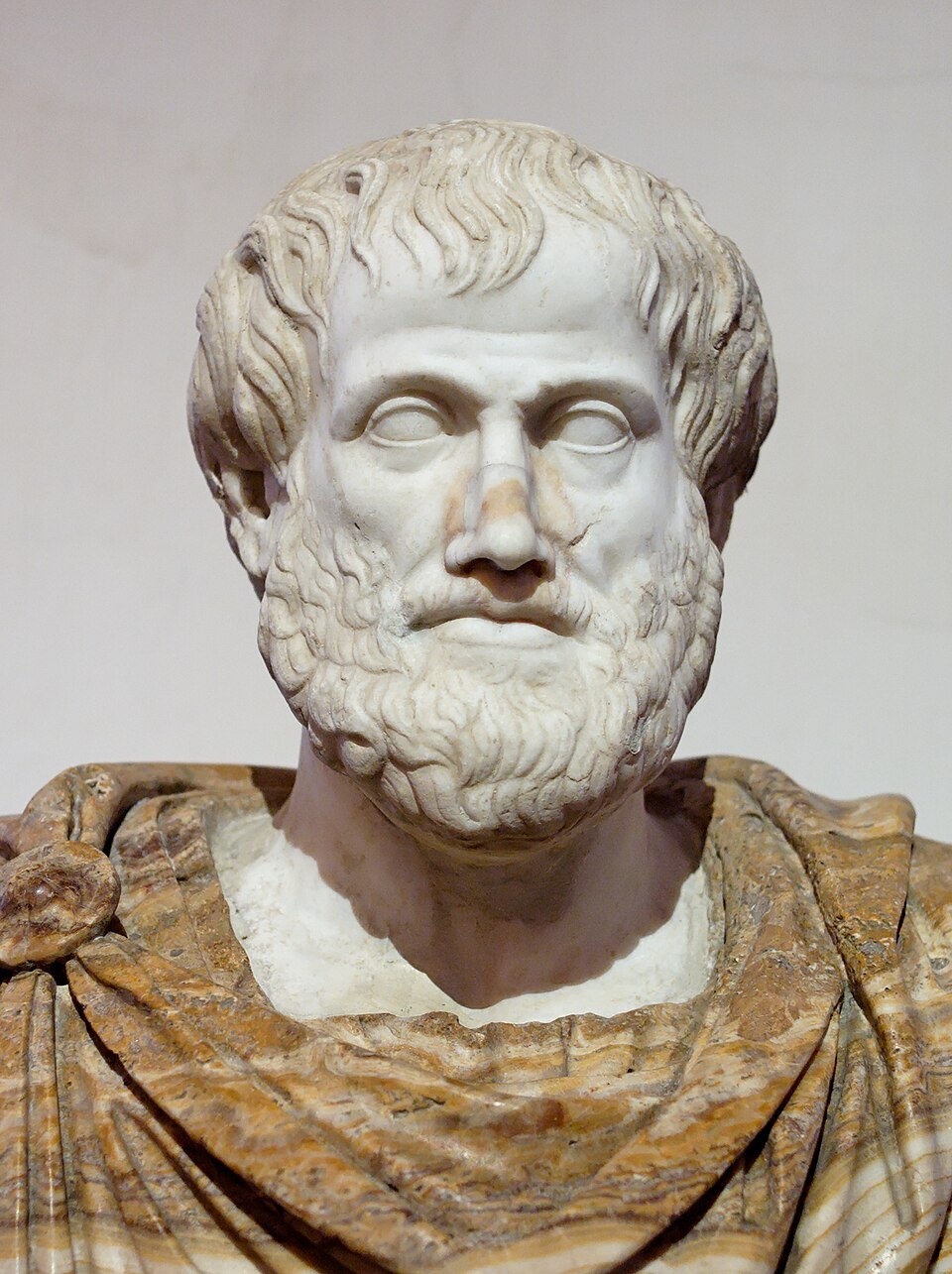
Upon returning to Athens, Aristotle founded his own school, the Lyceum. Unlike Plato’s Academy, which emphasized abstract philosophical debate, the Lyceum focused heavily on empirical research and systematic study.
Aristotle and his students:
Because Aristotle often taught while walking, his followers were known as the “Peripatetics” (from the Greek word for walking around).
Aristotle is often called the father of formal logic. He developed the first comprehensive system for analyzing arguments, known as syllogistic logic. A simple example of his reasoning structure:
This method of structured reasoning influenced philosophy, science, and education for centuries and became foundational to critical thinking.
Unlike Plato, who focused on abstract ideals, Aristotle emphasized studying the natural world directly. He carefully observed animals and attempted to categorize living organisms based on shared characteristics. Although some of his scientific conclusions were later corrected, his method of:
These helped establish the foundation of biological science.
In his ethical writings, especially the Nicomachean Ethics, Aristotle explored how humans achieve happiness (eudaimonia), which he defined as flourishing or living well. He proposed the idea of the Golden Mean:
For Aristotle, moral character develops through habit and practice, not simply knowledge.
In his work Politics, Aristotle analyzed different forms of government and argued that humans are “political animals,” naturally inclined to live in communities. He studied:
...and evaluated their strengths and weaknesses. His political theories influenced Western political thought for centuries.
Aristotle also made major contributions to metaphysics, the study of existence and reality. He proposed that everything consists of:
He also introduced the concept of the “Unmoved Mover,” a prime cause that initiates motion in the universe without itself being moved.
After Alexander the Great’s death, anti-Macedonian sentiment rose in Athens. Because of his association with Alexander, Aristotle faced political pressure and chose to leave the city rather than risk trial. He died in 322 BCE in Chalcis.
Aristotle’s writings were preserved and studied throughout the Middle Ages, particularly by Islamic scholars and later European philosophers. His ideas shaped:
For nearly 2,000 years, Aristotle’s works were considered authoritative in many fields.
Aristotle’s enduring importance lies in his method:
His approach bridges philosophy and science, making him especially relevant in modern STEM education. He showed that understanding requires both thoughtful reasoning and careful observation.


 Contact Us